Outer Worlds
The Caves of SteelThe Outer Worlds are the fifty worlds colonized from Earth that have become independent and, in many cases, wealthy societies. Their restrictions on immigration help define Earth’s crisis, while their reliance on robots and attempts to reshape Earth’s economy make them both a source of political pressure and a possible model for change. In the story, they are not a distant backdrop: their unequal relationship with Earth gives the investigation its wider stakes and ultimately informs its cautiously hopeful conclusion.
Former Colonies and Independent Worlds
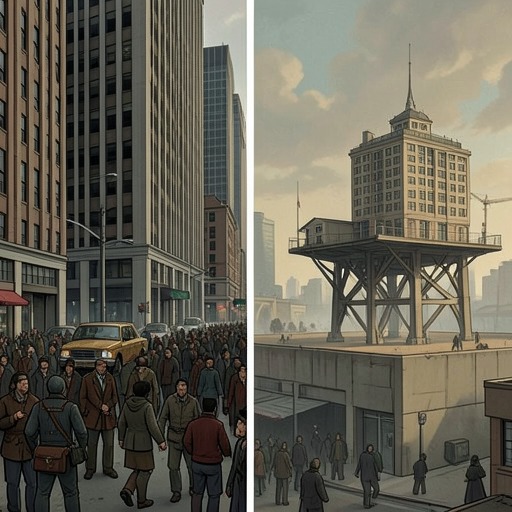
A millennium before the story, the Outer Worlds were Earth’s colonies. By the present, they are independent and notably self-assured; their political separation is part of a much longer transformation in which Earth’s descendants have developed societies distinct from the crowded planet they left. The contrast is not simply between Earth and space, but between Earth’s dense urban civilization and worlds whose smaller populations permit a different relationship to labor, technology, and comfort.
Earth’s cities represent a deliberate answer to population pressure. Over roughly a thousand years, scattered settlements gave way to immense, coordinated Cities, organized around residential Sections, transport routes, administration, industry, and food production. The narrative presents this concentration as a triumph of efficiency and environmental mastery, yet also as an arrangement under strain: Earth’s population continues to rise, and even the Cities cannot guarantee enough calories for everyone indefinitely. The Outer Worlds’ example therefore stands beside an increasingly precarious Earth, not as a simple alternative available to all, but as a comparison shaped by unequal resources and access.
Population, Immigration, and Political Conflict
The Outer Worlds’ immigration restrictions are a central cause of the divide. Earth’s population is eight billion, while the combined population of the fifty Outer Worlds is scarcely more than five and a half billion. The Spacers maintain their worlds’ comfort partly by keeping birth rates low and preventing immigration from crowded Earth. To people on Earth, this policy makes the open worlds beyond the planet appear closed precisely when Earth’s own population crisis makes departure seem necessary.
That exclusion carries political consequences. As conditions on Earth fail to improve, nationalist parties on the Outer Worlds gain strength. Their argument is that Earthmen differ from Spacers and cannot be fitted into the same traditions; they also warn that imposing robots on Earth by superior force could bring destruction to the Galaxy. The dispute thus joins demographic anxiety to a question of political legitimacy: whether Earth should accept an externally imposed social model, and whether the Spacers have the right to decide what is safe for it.
The book complicates the image of the Outer Worlds as a single, uncomplicated refuge. Their prosperity depends on sparse populations and restricted entry, while their political factions disagree over how far their influence over Earth should extend. The same difference that makes their societies appear enviable also underlies their distance from Earth and the fear that a solution designed for one population might damage another.
Robots and Competing Models of Society
Robots are established across the Outer Worlds, where a low population makes extensive robot labor compatible with their social order. Earth, by contrast, has historically confined robots largely to mines and farmland. Only during the preceding quarter-century, under Spacer pressure, have robots begun to enter Earth’s Cities. The contrast makes technology a political issue: robots are not merely tools but signs of a contested economic and cultural transformation.
The Spacers’ effort to introduce their C/Fe culture into Earth’s economy has been pursued with the cooperation of planetary and City governments, often because cooperation was expedient. After twenty-five years, however, the effort has failed to win Earth over, and the Medievalists have grown stronger in opposition. The failure reveals the limits of treating economic change as something that can be transferred from one society to another without winning a native constituency. Rather than proving that Earth can never change, it prompts a reconsideration of who must lead that change.
Differences in scale also shape the societies’ technical capacities. When R. Daneel Olivaw describes Earth’s computers as exceptionally massive and complex, he explains that even the largest Outer World scarcely has the population of one Earth City, so extreme computational complexity is less necessary there. The contrast is revealing: Earth’s dense urban organization produces machinery on a scale the sparsely populated worlds do not require, even as those worlds lead Earth in the everyday presence of robots.
Colonization and the Possibility of a Future
The Outer Worlds’ history also supplies an argument for renewed colonization. More than thirty of the fifty worlds, including Aurora, were directly colonized by Earthmen. In conversation with Baley, Dr. Han Fastolfe challenges the assumption that such expansion has become impossible. He points to estimates of a hundred million planets that are inhabitable or could be made inhabitable among the Galaxy’s hundred billion stars. The appeal is not merely to past achievement: it answers the claim that Earth’s population problem must be managed within the limits of the world it already occupies.
That possibility remains politically difficult. The worlds Earth once settled now restrict newcomers from the planet, and the existing Outer Worlds cannot simply absorb Earth’s population. Fastolfe’s appeal to the history of colonization instead turns the old pattern around: if Earthmen created new societies before, perhaps Earth can again expand outward rather than accept permanent confinement. The question is bound up with the book’s conflict over whether robotics and economic reform can alter Earth’s prospects, or whether a larger opening is required.
The investigation’s final outlook reframes the Outer Worlds’ intervention. R. Daneel Olivaw says that Spacetown has ended its project because it is satisfied Earth will colonize. He explains that the earlier attempt to change Earth by changing its economy did not work, and that Dr. Sarton had proposed reversing the strategy: find an element of Earth’s own population that wanted, or could be persuaded to want, the desired change, and help it make the movement native rather than foreign. This shift does not erase the Outer Worlds’ earlier pressure or the growth of opposition; it acknowledges that a future imposed from outside is less promising than one Earth itself can choose.
Narrative Significance
The Outer Worlds function as both a mirror and a challenge to Earth. Their low populations, controlled immigration, and robot-based economies expose the consequences of Earth’s crowding, but their political defenses also show that the advantages Earth envies are bound to exclusion and cannot simply be claimed without conflict. Their history of colonization keeps open the possibility of a different future, while their unsuccessful attempt to export C/Fe culture warns against confusing technical efficiency with social consent.
This tension shapes the book’s movement from dependence on Spacer intervention toward the prospect of Earth acting for itself. The Outer Worlds begin as powerful outsiders whose restrictions worsen Earth’s predicament and whose technology threatens to provoke resistance. By the end, they remain influential, but the proposed path forward depends on a change becoming Earth’s own undertaking. Their significance lies in that reversal: the worlds created by Earth are no longer an open destination, yet their existence helps make renewed Earth-led colonization imaginable.